
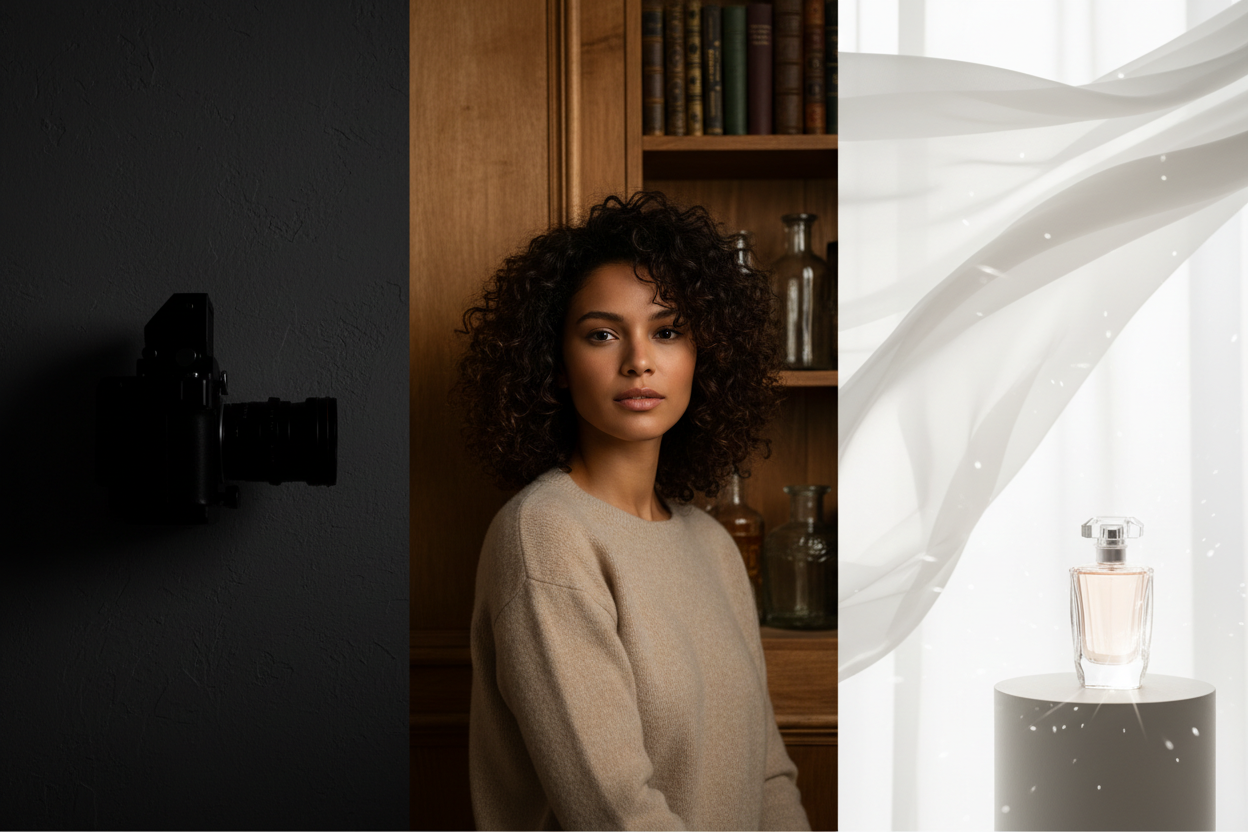
If you've spent any time in photography forums or scrolling through photo tips on Instagram, you've probably run into the term "20-60-20 rule." And if you Googled it hoping for one clean answer, you probably ended up more confused than when you started, because honestly, it means different things depending on who you ask.
That's not you missing something. The term genuinely gets used in a few different ways. So let's untangle it properly.
The short answer
Most of the time, when people talk about the 20-60-20 rule in photography, they mean a composition guideline: split your frame into three zones — roughly 20% for foreground or supporting elements, 60% for your main subject, and 20% for background or breathing room. The middle 60% carries the visual weight. The two 20% chunks frame it, add context, and keep things from feeling cramped.
Think of it as a looser, more flexible cousin of the rule of thirds.
But you'll also see the phrase used for a completely different idea — a shooting workflow popularized by wildlife photographer Paul Nicklen, where you spend the first 20% of a shoot locking in safe, reliable shots, the middle 60% refining your angles and light, and the last 20% experimenting with riskier ideas. Same numbers, totally different use case.
We'll cover both, but we'll spend most of our time on the composition version since that's what most people are actually searching for when they type "20-60-20 rule photography" into Google.
The composition version, explained properly
Here's the basic idea: instead of obsessing over exact grid lines like you do with the rule of thirds, you think in terms of visual weight.
60% — your subject. This is the heart of the photo. The person, the building, the mountain, the product — whatever the image is actually about. It should dominate the frame without question.
20% — foreground or one supporting side. This adds depth or context. A blurred branch in front of a portrait, a doorway leading into a room, a patch of flowers in front of a landscape.
20% — background or the other side. This finishes the story. Sky, horizon, a soft wall, negative space. It shouldn't fight for attention — it just needs to sit there and support the main event.
The numbers aren't meant to be measured with a ruler. Nobody's out there calculating exact pixel percentages mid-shoot. It's more of a mental habit: look at your frame and ask, "what's the 60% here, and is everything else actually helping it or just cluttering it up?"
A lot of photographers describe it in terms of attention instead of space. A small, sharp, well-lit object can carry the visual weight of "60%" even if it only takes up a fraction of the actual frame — because our eyes go straight to it. A face does this naturally. So does a bright object against a dark background.
How it's different from the rule of thirds
The rule of thirds asks you to place your subject along intersecting grid lines, roughly a third of the way into the frame. It's about placement.
The 20-60-20 rule is about proportion and hierarchy. It doesn't care where in the frame your subject sits — it cares how much visual dominance it has compared to everything else around it. You can absolutely use both at once: place your subject on a rule-of-thirds intersection, then use the 20-60-20 idea to decide how much of the frame it should actually occupy or command.
How this plays out across different types of photography
Portraits — The face is your 60%. Shoulders, clothing, or hands can be one 20%. A clean, uncluttered background is the other. If a busy background is stealing attention from the face, it doesn't belong.
Landscapes — Sometimes the land is your 60% and the sky fills out one 20%, with a tree or a road as the other. Or you flip it — a dramatic sky becomes the 60%, with the land supporting it underneath.
Street and lifestyle photography — A person is often your 60%, the surrounding buildings or street become one 20%, and light or motion fills the rest. This is usually where storytelling actually happens in a frame.
Product photography — The product needs to dominate. Props and background exist to support it, not compete with it. If everything in the shot is shouting for attention, the product loses.
Real estate photography — The room or space itself is usually the 60%. A window, staircase, or architectural detail can be one 20%, with lighting or depth (a hallway, a doorway) filling the rest.
None of this is a rigid formula. It's a way of training your eye to ask, before you press the shutter, "what actually deserves the viewer's attention here, and what's just noise?"
When to ignore it completely
Not every strong photo needs balance. Minimalist shots where one subject completely owns the frame, with nothing else competing at all, can be more powerful precisely because they break this rule. Rules like this are tools for building instinct, not laws you're breaking if you don't apply them. Once the "what's my 60%" question becomes automatic, you'll find yourself using it without even thinking about it — and knowing exactly when to throw it out.
A quick note on the workflow version
Since it comes up under the same name, it's worth mentioning: photographer Paul Nicklen described a different 20-60-20 approach for actual shoot management, especially in unpredictable conditions like fast-changing wildlife light or weather. The idea there is to spend the first 20% of your shooting time nailing safe, technically solid shots you know you can deliver, the middle 60% improving on those with better angles and light, and the final 20% trying riskier or more experimental ideas — since you've already banked usable images either way.
It's a completely separate concept from the composition rule, just sharing the same catchy name. If someone brings up "the 20-60-20 rule" in a shoot-planning context rather than a framing context, this is probably what they mean.
FAQ
Is the 20-60-20 rule an official or widely taught rule in photography?
Not in the way the rule of thirds is. It's more of an informal guideline that's picked up traction online, especially among portrait, wedding, and lifestyle photographers, as a simple way to think about visual hierarchy.
Do I need to measure the exact percentages while shooting?
No. Nobody is measuring 20% of a frame with a tape measure. It's a mental shortcut — glance at your composition and ask what's dominant, what's supporting, and what's just clutter.
How is the 20-60-20 rule different from the rule of thirds?
The rule of thirds is about where you place your subject in the frame. The 20-60-20 rule is about how much visual weight your subject has compared to everything around it. They're not competing rules — you can use them together.
Does this rule work for vertical or phone photos?
Yes. It works just as well top-to-bottom as it does left-to-right. Putting something interesting in the bottom 20% of a vertical shot, for example, can make a viewer feel like they're standing right in the scene.
Can breaking the 20-60-20 rule make a photo better?
Sometimes, yes. Minimalist compositions where a single subject fills almost the entire frame, with no supporting elements at all, can be more striking specifically because they ignore this balance. Treat it as a default, not a limit.
Is the 20-60-20 rule the same thing as the Paul Nicklen shooting method?
No, they just share a name. Nicklen's version is about how you allocate your time and risk during a shoot, not how you compose an individual frame.

Leave a comment
This site is protected by hCaptcha and the hCaptcha Privacy Policy and Terms of Service apply.