
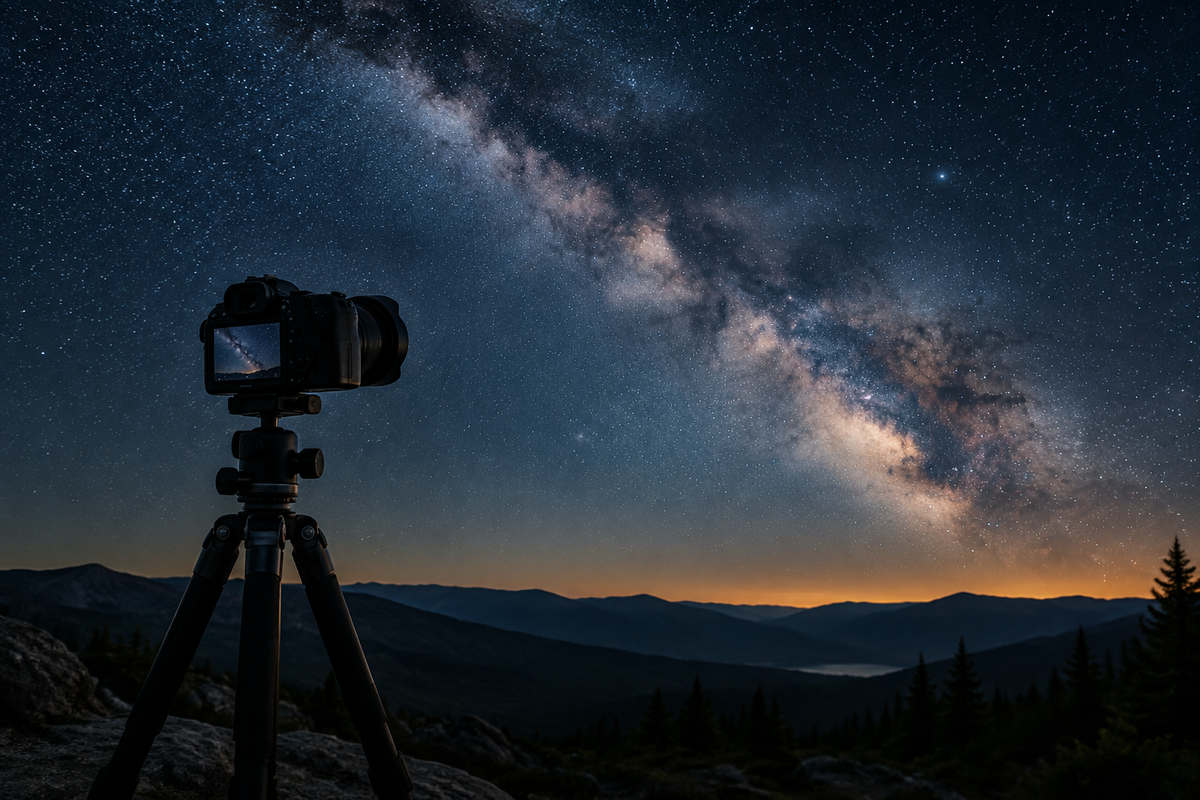
The 400 rule is a formula night photographers use to calculate the longest shutter speed that will keep stars looking like sharp points of light instead of streaks. Divide 400 by your lens focal length, adjusted for your camera's crop factor, and the result is your maximum exposure time in seconds. It is a stricter version of the older 500 rule, built for the high resolution sensors most of us shoot with today.
The Formula and Where It Comes From
The math is simple: maximum shutter speed in seconds equals 400 divided by focal length in millimeters, multiplied by your sensor's crop factor. Written out, that is t = 400 / (f x CF), where f is your lens focal length and CF is 1.0 for full frame, roughly 1.5 for most APS C cameras, and 2.0 for Micro Four Thirds.
This is one member of a whole family of reciprocal rules that all work the same way with a different constant on top, the 600 rule, the 500 rule, the 400 rule, and even a 300 rule for the most demanding sensors. Every version answers the same question, how long can the shutter stay open before the Earth's rotation turns a point of starlight into a visible trail. The only thing that changes is how conservative the number needs to be for your specific camera.
Why 400 Instead of 500
I shoot with high resolution bodies for most of my client work, and that habit carries over directly into how I think about night photography. The 500 rule was built in an era when 12 and 16 megapixel sensors were standard. A star trail that was invisible at that resolution becomes obvious once you are working with a 45 or 61 megapixel sensor, because you are simply packing far more pixels into the same frame, and each pixel has less room for a moving point of light to blur across before it becomes visible at full resolution.
That is the entire logic behind the 400 rule. It is not a different formula, it is the same formula with a tighter constant to compensate for pixel density. As a rough guide, cameras in the 20 to 24 megapixel range can usually stick with the 500 rule and get away with it. Once you move into the 30 to 45 megapixel range, the 400 rule gives a meaningfully safer result. Above 45 megapixels, many photographers move to the 300 rule, or skip the reciprocal rules entirely in favor of the more precise NPF rule.
Worked Examples
Numbers make this easier to trust than a rule of thumb on its own, so here is what the 400 rule actually produces across common focal lengths and sensor types.
| Lens focal length | Full frame, CF 1.0 | APS C, CF 1.5 | Micro Four Thirds, CF 2.0 |
|---|---|---|---|
| 14mm | 28.6 seconds | 19.0 seconds | 14.3 seconds |
| 20mm | 20.0 seconds | 13.3 seconds | 10.0 seconds |
| 24mm | 16.7 seconds | 11.1 seconds | 8.3 seconds |
| 35mm | 11.4 seconds | 7.6 seconds | 5.7 seconds |
| 50mm | 8.0 seconds | 5.3 seconds | 4.0 seconds |
Compare that against the older 500 rule at the same focal lengths and the gap is not small. A 24mm lens on full frame gets 20.8 seconds under the 500 rule but only 16.7 seconds under the 400 rule, a difference of about 4 seconds that can be the entire margin between pinpoint stars and a soft, slightly stretched result once you zoom into a 45 megapixel file at full resolution.
Beyond the 400 Rule, the NPF Rule
For a wide field shot at 14mm printed small, the 400 rule is close enough to get a strong result on the first try. For a tighter composition at 35mm or 50mm that you plan to crop into or print large, I usually reach for the NPF rule instead, developed by Frederic Michaud for the Societe Astronomique de France. It factors in your aperture, your sensor's actual pixel pitch, and the declination of the part of the sky you are shooting, since stars near the celestial equator move faster across the frame than stars near the poles. It is more math than most people want to do by hand in the field, which is exactly why apps like PhotoPills exist, but the 400 rule remains the fastest way to get a safe starting point before fine tuning.
How This Connects to Other Kinds of Photography Work
The same underlying idea, that focal length and resolution determine how much motion you can get away with before it becomes visible, shows up constantly outside of astrophotography. In handheld daylight work, the classic reciprocal rule states your shutter speed should be at least as fast as one divided by your focal length to avoid visible camera shake, the same logic as the 400 rule, just applied to a shaking photographer instead of a rotating planet. I lean on that thinking constantly in commercial photography work, where a client's brand guidelines demand tack sharp results across every focal length in a shoot.
It matters in product photography too, where even a slightly soft image reads as unprofessional next to a competitor's crisp listing photo, and in ecommerce photography, where a single blurry frame in a gallery of twenty can undercut trust in an entire product listing. Videography has its own version of the same principle, the 180 degree shutter rule, which keeps motion blur looking natural on camera by tying shutter speed to frame rate rather than focal length. Different math, same underlying goal, understanding exactly how much motion your sensor can tolerate before an image stops looking sharp.
Common Mistakes with the 400 Rule
The single most common error is forgetting the crop factor entirely and applying the plain focal length number as if shooting full frame. A 20mm lens on an APS C body is not a 20mm field of view, it behaves like roughly 30mm, and skipping that adjustment is why so many photographers with crop sensor cameras end up with trails despite technically following the rule.
The second common mistake is trusting the rule at 100 percent crop on a very high resolution file. The 400 rule is a solid starting point for web sized images and standard prints, but anyone planning a large print or a tight crop should treat it as a first pass and verify with a test exposure zoomed into actual pixels before committing to a full shoot.
FAQs
What is the difference between the 500 rule and the 400 rule?
Both use the same formula, focal length divided into a constant, adjusted for crop factor. The 500 rule uses 500 as the constant and suits lower resolution sensors, while the 400 rule uses a stricter constant of 400, giving a shorter, safer maximum shutter speed for higher resolution modern cameras.
Do I need to use the 400 rule on every camera?
No. Cameras in the 20 to 24 megapixel range often get acceptable results with the more relaxed 500 rule. The 400 rule becomes genuinely useful once you are shooting in the 30 to 45 megapixel range, where pixel density makes star trails visible sooner.
How do I apply the 400 rule on a crop sensor camera?
Multiply your lens's actual focal length by your camera's crop factor before dividing into 400. A 20mm lens on a 1.5x APS C camera behaves like 30mm, so the calculation becomes 400 divided by 30, giving roughly 13.3 seconds rather than the 20 seconds you would get by ignoring the crop factor.
Is the 400 rule accurate enough for professional astrophotography?
It is a strong starting point for most work, but photographers shooting for large prints or tight crops often move to the more precise NPF rule, which accounts for aperture, pixel pitch, and where in the sky the stars are located.
Why does megapixel count matter for star trail calculations?
Higher megapixel sensors pack more pixels into the same frame area, which means the same amount of star movement takes up a larger, more visible portion of the final image at full resolution, so higher resolution cameras need a stricter, shorter maximum shutter speed to keep stars looking sharp.
About David DuPuy
David DuPuy is a New York City based photographer and videographer with 20 years of experience specializing in real estate, ecommerce, and commercial photography. He has worked with businesses, brands, real estate professionals, and organizations, including Douglas Elliman, Sothebys, Edelman, Citibank, Mount Sinai, and 60 Minutes. David writes about photography pricing, property marketing, and visual storytelling based on hands on experience creating professional images and videos for clients in New York City and worldwide.



Leave a comment
This site is protected by hCaptcha and the hCaptcha Privacy Policy and Terms of Service apply.