
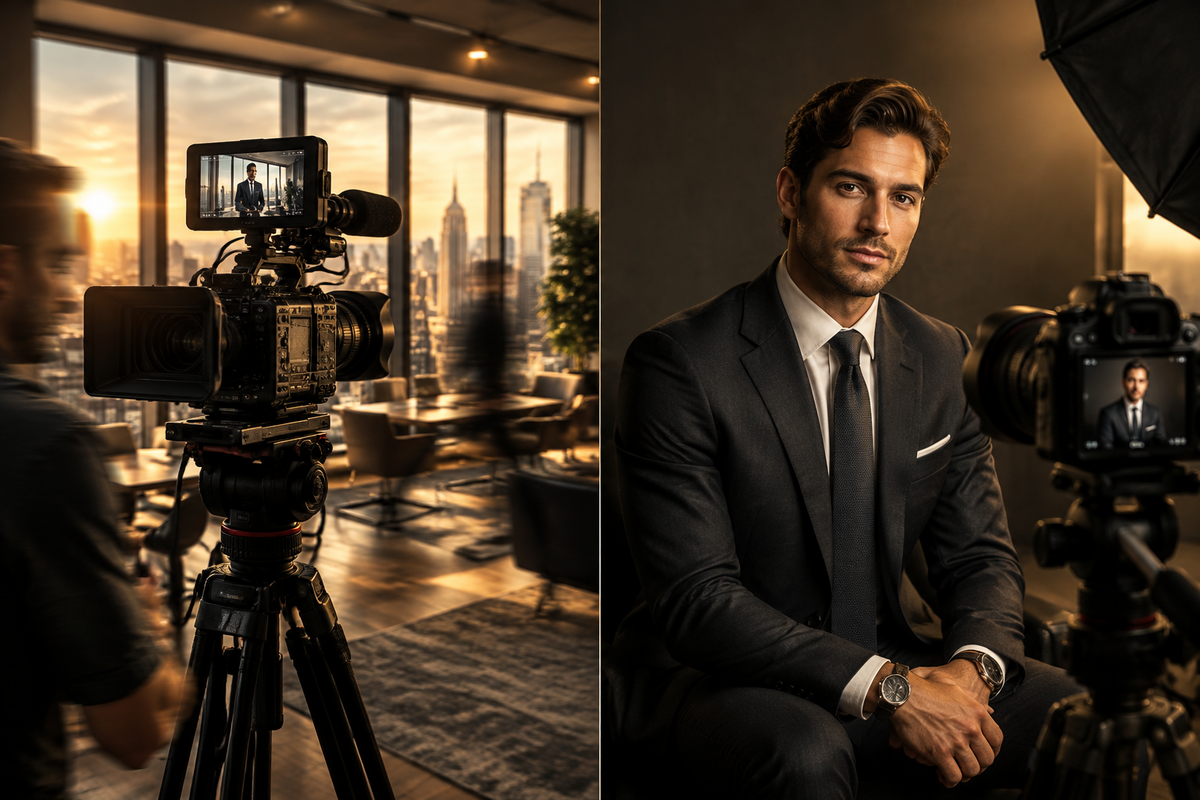
Most companies ask this question backwards. They decide they want video because a competitor has one, or they decide they need new photography because the website looks dated, without actually checking which problem that spending would solve. The data on each medium points in genuinely different directions, and the right answer depends less on preference and more on where your business is weakest right now.
How many businesses are actually using each one
Video adoption among businesses reached 91 percent in 2026, matching an all time high, and 82 percent of marketers who use it report a good return, though that figure has slipped from 93 percent the year before as more companies crowd into the format. Photography does not get tracked the same way because it is assumed, nearly every business already has some kind of photography on its website, its proposals, and its social profiles. The real question was never whether to use photography at all. It is whether the photography you already have is helping or quietly working against you.
What photography does that video cannot replace
Photography's entire job is building instant trust in the few seconds before someone decides whether to keep reading. The data on this is unusually consistent across industries. Google Business Profiles with photos get 42 percent more direction requests and 35 percent more website clicks than profiles without them. A driving school that swapped a stock photo for a real photo of an actual student saw conversions on its signup page jump 161 percent. A moving company that replaced a generic stock image of people carrying boxes with a photo of its real crew earned 45 percent more quote requests. In a separate test, a company found that simply using a real photo of its founder instead of a generic headshot style image lifted conversions by 35 percent. None of these companies changed their offer, their pricing, or their copy. They changed one photo.
What video does that photography cannot replace
Video's strength shows up further down the decision, after trust is already established and a prospect needs to actually understand something complex, how a product works, what a company culture feels like, or why a service is worth a premium price. In 2026, 85 percent of marketers using video say it has directly generated leads, and 83 percent say it has directly increased sales. LinkedIn has become the dominant channel for this kind of content among B2B companies specifically, which matters if your buyers are other businesses rather than individual consumers. Photography rarely moves someone from curious to convinced on its own. Video is built for exactly that transition.
Where each one actually gets used
Photography carries the weight on your homepage, your About page, your LinkedIn profile and company page, your press kit, your proposals, and anywhere a prospect forms a first impression in under a few seconds. Video carries the weight in onboarding and training content, culture and recruiting content, product explainers, sales enablement material a rep sends mid conversation, and any social content meant to hold attention for more than a glance. The overlap between these two lists is smaller than most companies assume, which is part of why the decision rarely needs to be either or.
What each one actually costs
Photography pricing for a typical business shoot, headshots, team photos, office and product imagery, usually runs from a few hundred dollars for a small batch up to a few thousand for a full day covering multiple locations and use cases. Corporate video pricing moves on a different scale entirely. Industry data from Clutch, Vidico, and other production trackers puts standard corporate and training video at 1,000 to 10,000 dollars per finished minute, with brand films running 8,000 to 25,000 dollars per minute for the highest end productions. A full project, start to finish, commonly lands somewhere between 2,500 dollars for a basic internal piece and 50,000 dollars or more for a polished brand campaign. That gap in scale is exactly why photography is usually the right place to start for a company without a strong budget yet, it fixes the most visible trust problem for the least money.
A simple way to decide which to fund first
If your current photography is dated, inconsistent, or leaning on stock images, fix that first regardless of how much you want a video. Every channel a prospect touches, your website, your LinkedIn page, your proposals, depends on photography working correctly, and a strong video sitting next to weak photography still inherits that weak first impression. Once your photography is solid and consistent, video becomes the better next investment, specifically for whichever single use case matters most to your pipeline right now, a product explainer if sales cycles stall on understanding, a culture video if recruiting is the bottleneck, rather than a generic brand video with no specific job to do.
Why most mature marketing programs eventually use both
Once a company passes a certain size, the question stops being which one to choose and becomes how to sequence the investment. Photography keeps every other channel credible. Video does the harder work of moving someone from interested to convinced. Treating them as competing budget lines usually means underfunding whichever one gets decided against, when the stronger move is almost always funding photography to a solid baseline first, then adding video around the one or two moments in your funnel where attention and explanation matter more than a quick first impression.
If your company specifically needs real estate listing photography or video, or professional headshots for a team rather than general brand content, those decisions come with their own numbers and tradeoffs worth looking at separately rather than folding into a general comparison like this one.
For general commercial imagery, see commercial photography. For video production across training, culture, product, and brand content, see videography.
FAQs
Should a small business invest in photography or video first?
Photography almost always comes first for a small business, since it is cheaper, touches more of the marketing funnel at once, and directly affects trust on every channel a prospect sees before they would ever watch a video.
How much does corporate video actually cost compared to photography?
Photography for a typical business shoot usually runs a few hundred to a few thousand dollars. Corporate video runs on a different scale entirely, commonly 1,000 to 10,000 dollars per finished minute for standard corporate content, and 2,500 to 50,000 dollars or more for a full project depending on production quality.
Does using real photos instead of stock photos actually improve conversions?
Yes, consistently. Published A/B tests across different industries have found conversion lifts ranging from 35 percent to over 160 percent when real photos of people, teams, or founders replaced stock imagery.
What is corporate video actually best used for?
Video performs best further down the decision process, once trust already exists, explaining how a product works, showing company culture to recruits, or supporting a sales conversation already in progress rather than creating a first impression from scratch.
Is it a mistake to invest in video before fixing outdated photography?
Generally yes. A strong video next to outdated or inconsistent photography still inherits the weaker first impression the photography creates, since most prospects encounter photography, on a website or LinkedIn profile, before they ever click play on a video.
About David DuPuy
David DuPuy is a New York City based photographer and videographer with 20 years of experience specializing in real estate, ecommerce, and commercial photography. He has worked with businesses, brands, real estate professionals, and organizations, including Douglas Elliman, Sothebys, Edelman, Citibank, Mount Sinai, and 60 Minutes. David writes about photography pricing, property marketing, and visual storytelling based on hands on experience creating professional images and videos for clients in New York City and worldwide.



Leave a comment
This site is protected by hCaptcha and the hCaptcha Privacy Policy and Terms of Service apply.